CUI: Advanced Imaging of Matter
Cluster of ExcellenceCUI: Advanced
Imaging of Matter
Imaging of Matter
Photo: UHH/CUI, Peter Garten
8 July 2026
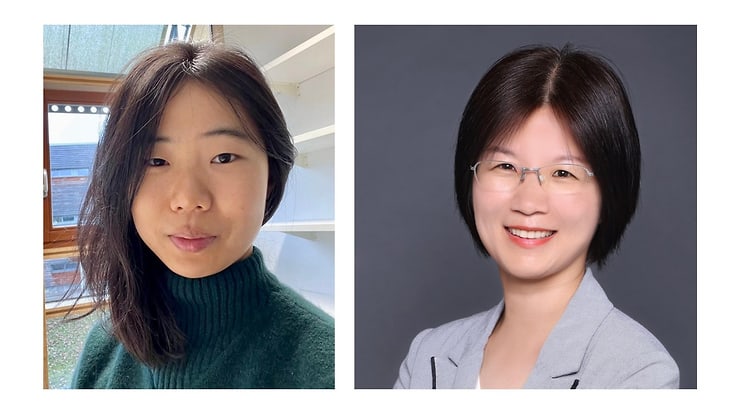
Photo: private
Prof. Shuyun Zhou from Tsinghua University, China, and Prof. Suzy Zhang from Okinawa Institute of Science and Technology (OIST) Graduate University, Japan, have been awarded the Mildred Dresselhaus Guest Professorship 2026 by the Hamburg Centre for Ultrafast Imaging (CUI). The program includes an extended research stay at the Cluster of Excellence "CUI: Advanced Imaging of Matter" and prize money of €20,000 for the Senior Award and €10,000 for the Junior Award.
The Senior Award goes to Shuyun Zhou, Professor at the Department of Physis at Tsinghua University, Beijing, China, and a world-renowned pioneer in experimental optical and condensed matter physics research. She is particularly known for her seminal contributions to electronic-structure engineering and light-field control of two-dimensional materials and heterostructures.
“I warmly congratulate Shuyun. She is an outstanding researcher in quantum materials and a world-leading expert in the study of their ultrafast dynamics. Shuyun also has strong ties to physicists in Germany, and we believe her sabbatical in Hamburg will be of great benefit to our community,” says Andrea Cavalleri, Professor at the University of Hamburg and Director of the Max Planck Institute for the Structure and Dynamics of Matter (MPSD).
Zhou has natural collaborations with Cavalleri’s group on non-equilibrium dynamics in quantum solids, with Prof. Francesca Calegari (UHH, DESY) in photo-emission spectroscopy at extreme timescales, with Prof. Jie Shan and Prof. Kin Fai Mak (both MPSD) on controlling electronic properties of low dimensional systems using both equilibrium and non-equilibrium tuning methods, and with Prof. Angel Rubio (MPSD, UHH) on Floquet engineering in two-dimensional materials, moiré control and related topics at the interface between experiment and theory.
Shuyun Zhou: “Mildred Dresselhaus has been an inspiring role model for me since the early days of my scientific career. I still vividly remember seeing her at the APS March Meeting during my Ph.D. studies more than twenty years ago, and it is a great honor to receive the Guest Professorship that bears her name. The Hamburg Centre for Ultrafast Imaging is internationally recognized for its pioneering research in ultrafast science, and I am excited about the opportunity to interact with outstanding scientists, deepen existing collaborations, build new ones, and explore new directions in ultrafast quantum materials and light-matter interactions."
Zhou studied physics in China and earned her PhD at the University of California, Berkeley, USA. She then worked as a postdoctoral researcher at Lawrence Berkeley National Laboratory, before becoming Associate Professor and later Professor at the Department of Physics at Tsinghua University.
Her contributions have been recognized with numerous honors, including the Xplorer Prize, the Huang Kun Physics Prize of the Chinese Physical Society, Changjiang Distinguished Professor, National Science Fund for Distinguished Young Scholars, and the L’Oreal-UNESCO Award for Women in Science in China. She is an elected Council Member of the Chinese Physical Society and served as a Member of Commission on Structure and Dynamics of Condensed Matter for the International Union of Pure and Applied Physics.
Zhou is committed to mentoring the next generation of scientists. As a recipient of the L'Oréal-UNESCO Award for Women in Science in China, she advocates for advancing women in science and strives to build a physics community in which diversity and equal opportunity are valued.
The Junior Award goes to Suzy Zhang, a tenure-track Assistant Professor at the Okinawa Institute of Science and Technology (OIST) Graduate University in Japan. She leads the independent research unit “Collective Dynamics and Quantum Transport”. Her research explores the dynamics and transport of different kinds of quantum matter, with the aim of uncovering emergent many-body phenomena and potential functionalities of spintronics, electronics, and quantum-information. Zhang combines methods from quantum many-body physics, mesoscopic physics, and quantum optics, enabling close collaborations with University of Hamburg researchers Dr. Thore Posske and Prof. Martin Eckstein on spin chains and transport. Further projects may include collaborations with the groups led by Prof. Andrea Cavalleri, Prof. Angel Rubio, Prof. Jie Shan, and Prof. Kin Fai Mak.
“I sincerely congratulate Suzy. Her expertise in light-matter interaction in quantum spin systems is deeply rooted and closely aligned with cutting-edge topics in the field that we intend to study. Additionally, Suzy is a powerhouse in a wide range of theoretical methods. I am very much looking forward to hosting her in Hamburg and to discussing stimulating research ideas,” says Thore Posske.
Suzy Zhang: “I am deeply honored and grateful to have been selected as a recipient of the Mildred Dresselhaus Guest Professorship. I would like to express my sincere appreciation to the selection committee for this recognition, and to my host, Thore, for his generous support and invitation. I have long been drawn to the outstanding research environment in Hamburg and, in particular, the pioneering work carried out at CUI and MPSD in the fields of nonequilibrium quantum matter. It is a privilege to have the opportunity to spend an extended period here, to learn from and collaborate with the many excellent researchers across the center, and to contribute to its vibrant scientific community.”
Suzy Zhang studied physics in China and completed her PhD in the United States, where she also spent the first years as a postdoctoral researcher. She then joined the Max Planck Institute for the Physics of Complex Systems in Dresden, Germany. She became Junior Group leader at the Leibniz Institute for Solid State and Materials Research Dresden and started as Assistant Professor at OIST in 2025.
She has received numerous awards, including the Distinguished PKS Postdoctoral Fellow at the Max Planck Institute for the Physics of Complex Systems in Dresden, five fellowships and scholarships in China and the United States, and the Chancellor’s Award of the UCLA for outstanding postdoctoral research. As a first-generation academic, she is a role model for showing how the global academic system can be both rigorous and full of opportunities - reflecting the spirit of Mildred Dresselhaus.