• Zur Metanavigation
  • Zur Hauptnavigation
  • Zur Suche
  • Zum Inhalt
  • Zur Subnavigation
  • Zum Seitenfuß
  • University of Hamburg
  • For journalists
  • Staff Service Portal0
  • STiNE
https://www.kus.uni-hamburg.de/aktuelles.json?recentnews=true
  • Institutions and target groups
    • Einrichtungen
      • Faculties

        • Faculty of Law
        • Faculty of Business, Economics and Social Sciences
        • Faculty of Medicine
        • Faculty of Education
        • Faculty of Humanities
        • Faculty of Mathematics, Informatics and Natural Sciences
        • Faculty of Psychology and Human Movement Science
        • University of Hamburg Business School
      • Services

        • Study Information Net STiNE
        • Surfmail
        • Exchange
        • Staff Service Portal
        • Learning Platforms
        • Katalogplus – Catalogue of Hamburg Libraries
        • SharePoint
      • Student facilities and services

        • Campus Center
        • Career Center
        • PIASTA
        • AStA (student council)
        • University Sports
        • University Music
        • Family Office
        • University Language Center
        • General Languages
        • Office of Affairs for Students with Disabilities or Chronic Diseases
        • Departmental libraries
        • Healthy Campus
      • Further facilities and services

        • The Cluster of Excellence CLICCS
        • The Cluster of Excellence CUI
        • The Cluster of Excellence Quantum Universe
        • The Cluster of Excellence Understanding Written Artefacts
        • Hamburg Research Academy
        • Pier Plus
        • Hamburg Center for University Teaching and Learning (HUL)
        • Hub for Crossdisciplinary Learning (HCL)
        • CEN
        • Museums and collections
        • University Archives (in German)
        • Regional Computing Center (RRZ)
        • University Administration
        • Knowledge Exchange Agency
        • The Unikontor Shop (in German)
    • Target groups

      • Prospective students
      • Students
      • International prospective students
      • Young researchers
      • Researchers
      • Instructors
      • Staff
      • Prospective continuing education students
      • Alumni
      • Journalists
      • Refugees (in German only)
    Close
  • Language
    • English
    • Deutsch
  • /en/sitemap.json
University of Hamburg - to research, to teach, to educate and form, to homepage

CUI: Advanced Imaging of Matter

Cluster of ExcellenceCUI: Advanced
Imaging of Matter
  • About CUI
    • What we do
    • Who we are
    • Participating Institutions
    • Facts and Figures
    • News
    • Transfer
    • Interviews and Portraits
  • Research
    • Research in Area A
    • Research in Area B
    • Research in Area C
    • CUI in Focus
    • CUI: Task Force on Machine Learning
    • Research Highlights
    • Publications
    • Scrolly
  • Career
    • Graduate School
    • Job Openings
  • Diversity
    • Equity
    • Women's Lunch
    • Compatibility
    • Interculturality
    • Mental Health
    • LGBTQI*
    • Antidiscrimination & Power Abuse
    • Past Events & Initiatives
  • Outreach
    • School Programs
    • Arts & Science
    • Unit Cell
    • Magazines
    • Events
  • Service
    • Contact
    • Links and forms
    • Approach and site plan
    • Good to know

Photo: UHH/CUI, Peter Garten

  1. UHH
  2. CUI: Advanced Imaging of Matter
  3. About CUI
  4. What we do

What we do

“More is different”. This famous statement by Nobel laureate P. W. Anderson directly leads to one of the greatest and most exciting challenges of contemporary science: to understand how collective behavior and functionality emerge from the interaction of many interacting building blocks. The cluster’s central objective is to understand emergent phenomena of matter and – going one step further - to dynamically create new functionalities.

The project relies on different approaches: One of the visions is to stabilize transient room-temperature superconductors using light. An equally far-reaching vision is to study the strongly correlated motions of electrons and nuclei and to control their “dance” underlying the miracle of chemistry. Further, can we image proteins in action during their work within the machinery of life and ultimately steer their function by light?

Functionalities in non-equilibrium

What unifies all these examples is the non-equilibrium nature of the emergence of key phenomena: Nature is not static! Non-equilibrium emergence – its understanding and control – is the overarching theme of the cluster. Central to its success is the imaging of the dynamics of complex physical and chemical systems in real time, on the atomic scale.

We will explore the dynamics of complex systems, bridging concepts and methodologies for the study of ‘small’ well controlled quantum systems to ever greater length scales and complexity, from large molecules to solid state systems and nano systems. The key enabling features are both the critical mass of excellent scientists in Hamburg in the fields of photon and nanoscience, and our new methodological capabilities, developed during the last decade, to scrutinize matter at the scales of angstroms and femtoseconds.

Promotion of young scientists

All members of the cluster are committed to the promotion of young scientists, gender equality and improved compatibility of scientific work and family as a central guiding theme. We will strategically invest more than 80 % of the funding to employ and to train our PhD students, postdocs and early career scientists to become the next generation of multidisciplinary scientists in our newly created field of research. They will operate in Hamburg’s unique scientific environment with access to its exceptional infrastructure, including an unparalleled suite of light sources and instruments to manipulate and image matter on the atomic scale.

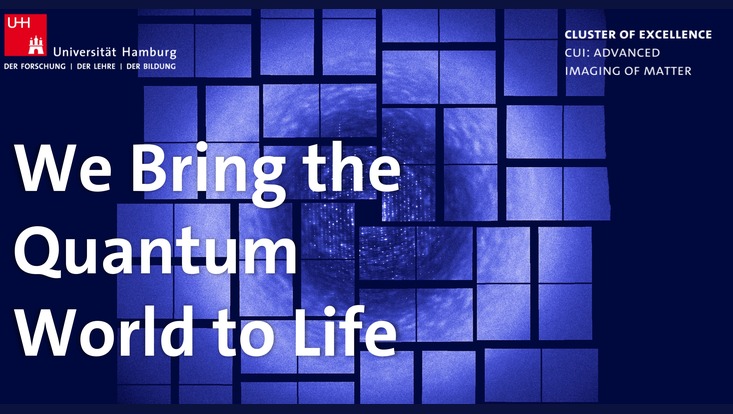
Click and scroll to find out what we are doing and why:
Close collaboration of partners

They will be supported by a tightly coordinated team of senior scientists from the University of Hamburg, the Helmholtz Centre DESY, the Max Planck Society and the European XFEL GmbH, working in close collaboration. All in all, Hamburg will be in an excellent position for exploring the small and fast in order to understand and control the large and complex.

The cluster is funded by the German Research Foundation (DFG) within the Excellence Strategy of the Federal and State Governments.

A project of the University of Hamburg in cooperation with
 

Related pages

  • About CUI
  • Who we are
  • Participating Institutions
  • Facts and Figures
  • News
  • Transfer
  • Interviews and Portraits

Last update: 15 July 2026

  • Feedback
  • Legal notice
  • Privacy statement
  • Accessibility
  • Site map

University of Hamburg

Innovating and Cooperating for a Sustainable Future in a Digital Age

  • Follow us on Instagram.
  • Follow us on Facebook.
  • Connect with us on LinkedIn.
  • Follow us on Mastodon.
  • Follow us on Bluesky.
  • Subscribe to our channel on YouTube.
    • Studies
    • Prospective students
    • Continuing education
    • Research
    • Teaching at UHH
    • Doctoral studies
    • Job opportunities
    • Knowledge exchange
    • University
    • Excellence
    • Faculties
    • Alumni
    • Contact
    • Campus Navigator
    • UHHApp
    • Emergencies, safety and security
    • Antidiscrimination
Go to family-friendly higher education institution audit
Go to internationalisation re-audit
Go to the Sustainability Audit page
Go to Diversity Audit
Go to System accreditation

© 2026 University of Hamburg. All rights reserved