CUI: Advanced Imaging of Matter
Cluster of ExcellenceCUI: Advanced
Imaging of Matter
Imaging of Matter
Photo: UHH/Denstorf
17 December 2025

Photo: Xian et al.
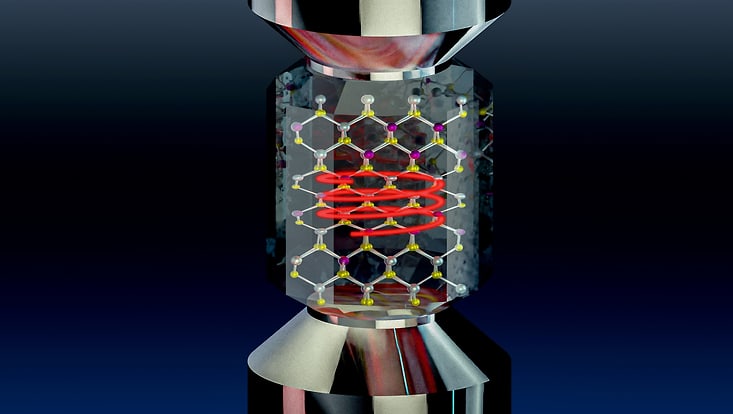
Researchers at the Max-Planck-Institute for the Structure and Dynamics of Matter (MPSD) and partner institutes have developed a general and experimentally realistic method to create square-lattice moiré materials by twisting two-dimensional semiconductors with rectangular unit cells by 90 degrees. This simple geometric recipe produces moiré patterns with square symmetry and flat, isolated electronic bands that map onto a tunable square-lattice Hubbard model—the theoretical framework underpinning magnetism and high-temperature superconductivity. The approach works across a broad class of materials and offers powerful knobs to explore correlated-electron phases in a clean, gate-tunable platform.
A new study introduces a broad and practical scheme for engineering square-lattice moiré systems—a long-sought goal. While moiré physics has been widely explored in triangular and honeycomb materials, square lattices have been rare because few naturally square 2D crystals exist. The researchers propose a simple alternative: take two or more rectangular-lattice two-dimensional materials—such as GeX and SnX monochalcogenides—and rotate them by exactly 90 degrees.
This rotation creates a predictable lattice mismatch along both in-plane directions. When the two lattice vectors differ slightly, they form a long-wavelength moiré pattern that is nearly an ideal square lattice. Using large-scale first-principles simulations on twisted GeS, GeSe, SnS and multilayer variants, the team shows that the spatially varying interlayer registry generates narrow, isolated flat bands at the conduction-band edge. These bands are well captured by a square-lattice Hubbard model with tunable parameters—including nearest-neighbor and next-nearest-neighbor hopping—providing a clean platform to study correlated-electron behavior.
Because the bands are so flat, electron–electron interactions dominate. With ab-initio-derived interaction parameters, the half-filled flat band can form a Mott insulator with Néel antiferromagnetic order, where the magnetic moments reside not on atoms but on moiré-scale orbitals.nThe platform offers exceptional control: material choice and layer number tune magnetic frustration, while electric displacement fields continuously adjust band anisotropy. This flexibility enables systematic exploration of antiferromagnetism, stripe order, pseudogap behavior and unconventional superconductivity.
This excites the co-author and MPSD Director Angel Rubio, who is a researcher in the Cluster of Excellence "CUI: Advanced Imaging of Matter": “The surprising thing is how simple the idea turned out to be. By twisting two rectangular layers by 90 degrees, a clean square lattice appears almost automatically. Once we saw how robust this mechanism was, we realized it could open a large new direction in moiré research.”
Lede Xian, co-author, hopes fellow researchers will use their result in their future work:“We hope this work encourages the community to look more widely at two dimensional materials. Rectangular lattices are more common, and with a simple 90 degree twist they can become a powerful playground for strongly interacting electrons.”
The study was performed by the Max-Planck-Institute for the Structure and Dynamics of Matter together with colleagues from the RWTH Aachen, the Tsientang Institute for Advanced Study and University of Pennsilvania. Text: MPSD, ed.
Q. Xu, A. Fischer, N. Tancogne-Dejean, T. Zhang, E. Viñas Boström, M. Claassen, D. M. Kennes, A. Rubio, L. Xian
Physical Review X 15, 041049 (2025)