CUI: Advanced Imaging of Matter
Cluster of ExcellenceCUI: Advanced
Imaging of Matter
Imaging of Matter
Photo: UHH/Denstorf
23 July 2026
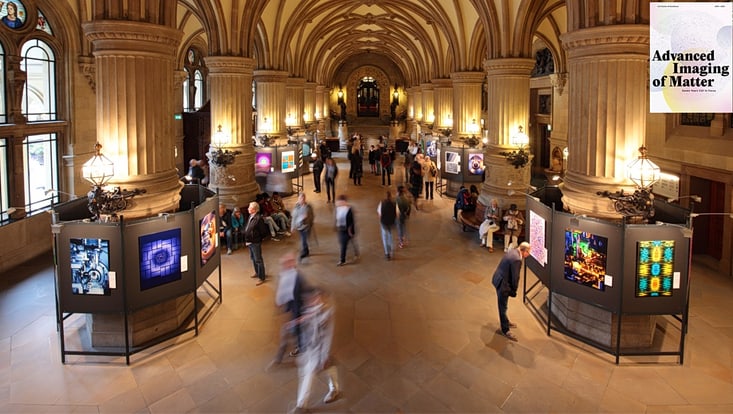
Photo: UHH/CUI, Peter Garten
The new magazine “Advanced Imaging of Matter: Seven Years CUI in Focus” highlights the progress made by the scientists of the Cluster of Excellence “CUI: Advanced Imaging of Matter,” as well as the beauty that lies hidden in basic research. In part four of our series, we present the “Arts & Science” initiative, in which the cluster takes the readers on an associative journey through the natural sciences.
Since its launch in 2017, the Cluster of Excellence's Arts & Science Initiative has established itself as a highly successful means of communicating science. “We would like to invite visitors to discover the artistic and aesthetic aspects of science,” said former CUI board member Prof. Peter Schmelcher at the opening of the first exhibition in the foyer of Hamburg City Hall. Everyday research is characterized by a pioneering spirit and a scientific focus, he said, and not very often, one gets a chance to change perspective. “If you get involved, you see an incredible diversity.”
As part of the initiative, researchers in the Cluster were asked to submit aesthetically pleasing images. The focus was not so much on the timeliness and scientific significance of the images but more on their aesthetics. In selecting the images, the organizing team was assisted by Julia Lohmann, then a professor at the Hamburg University of Fine Arts (HFBK) with a particular research interest in the intersection between science and art.
“Art can make science comprehensible, while at the same time science enables art to work.” Science is the expansion of sensory abilities. The common ground can be found in a feeling that is referred to as ‘wonder’ in English. This is a broad term that goes far beyond the German ‘Staunen’. Rather, it describes the desire for knowledge, triggered by something beautiful, remarkable or unknown. Lohmann also referred to a so-called double-take in the exhibited pictures – the recognition of something new at second glance. From a distance, for example, you can see a textile structure, while up close it is about atomic dynamics. “An associative journey begins as you approach.”
The visualizations are complemented by photos of the state-of-the-art laboratories and light sources as well as short texts about the research work and the working groups. In this way, the exhibition appeals to visitors on several levels: As an eye-catcher, as a gateway to scientific stories, as a starting point for a more in-depth exploration of research. “Everyone is drawn in by the first visual impression, which provokes questions and comments, stimulates thought and gives a completely new perspective on science,” says Prof. Ludwig Mathey, who contributed an illustration on magnetism to the first exhibition. “Talking about the pictures with the many visitors and viewers at the exhibition, discussing the amazement, the colors and shapes, was stimulating and motivating.”
During the two-week exhibition in 2017, tens of thousands of people from Germany and abroad, school classes and other groups viewed the images. The exhibition was subsequently shown at other events, such as the “Night of Knowledge” in Hamburg and the inauguration of the European XFEL. In April 2023 and 2024, the Cluster was able to build on its great success: almost 60,000 people saw a follow-up exhibition with new images and videos linked via QR code at Hamburg City Hall and Hamburg Airport.
The exhibition was complemented by an accompanying brochure, a movie and a series of calendars, which have proved very popular. Prof. Ludwig Mathey: “The exhibition continues to have an impact, even with the calendars that resulted from it. I see the calendars hanging in primary school classes, doctors' practices and private homes, showing science as aesthetically pleasing, amazing and diverse in all its forms.” Text: Ingeborg Adler