CUI: Advanced Imaging of Matter
Cluster of ExcellenceCUI: Advanced
Imaging of Matter
Imaging of Matter
Photo: UHH/Denstorf
29 September 2026
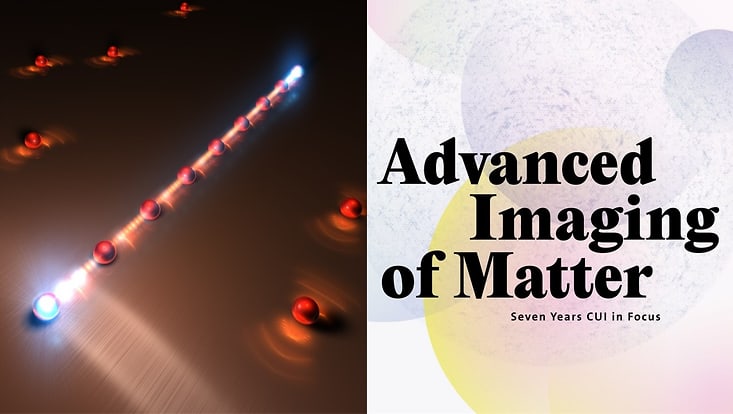
Photo: UHH, Lucas Schneider (left); UHH/CUI (right)
Experimental and theoretical groups at CUI use cleverly lined-up atoms to create new exotic “quasiparticles”. To do this, they combine magnetism and superconductivity on the atomic scale. The resulting particles – known as Majorana particles – have the potential to revolutionize the storage and manipulation of quantum information in quantum computers. In the magazine “Advanced Imaging of Matter – Seven Years CUI in Focus,” the scientists shine light on the possibilities.
New types of particles, such as the Higgs boson, which was first detected in 2012, can be discovered not only in particle accelerators but also as so-called quasiparticles in metals, semiconductors and superconductors. Quasiparticles are generally created by the interaction of electrons or other elementary particles and are of great interest for a variety of technological applications. Researchers from Prof. Roland Wiesendanger's group have made great strides towards the creation of novel exotic quasiparticles by precisely chaining magnetic atoms together on a super-conductor. If such a chain of magnetic atoms is correctly aligned, Majorana particles can be created. The process was successfully modeled in collaboration with the CUI theory groups of Prof. Michael Thorwart and Dr. Thore Posske, describing the formation of Majorana particles in atomic chains of different lengths.
Simulations of long atomic chains find Majorana particles at their ends, while those of shorter chains find their precursors. For downstream applications, it is crucial that quantum information can be stored in both Majorana particles and their precursors. This information can be manipulated by swapping Majorana particles within networks of chains to perform calculations. This makes Majorana particles promising candidates for quantum computers, particularly as it has been theoretically demonstrated that such computers are fault-tolerant, i.e. robust against imperfections.
The work emphasizes how uncomplicated local collaboration between experimenters and theorists can stimulate one another to achieve something unique world-wide. “Inspired by the experiments on the chains, we further explored Majorana particles in magnetic vortices and were able to show that error-free quantum computing up to the gigahertz range – i.e. up to several billion operations per second – is possible. In 2024, we were granted a US patent for quantum computing with Majorana particles,” says Posske. “We have also proposed a direct identification of these exotic particles using spectroscopic methods”.
In addition, the results of the Hamburg researchers open up the field of synthetic Shiba materials, with far-reaching potential for basic research into exotic states of matter and applications in quantum technologies. This involves using the tip of a scanning tunneling microscope to position magnetic atoms, known as Shiba atoms, with atomic precision on a superconducting surface. This enables the interaction between the atoms and the hybridization of their associated quantum mechanical states to be manipulated in a targeted manner. “The possibilities are almost limitless,” says Dr. Lucas Schneider, postdoctoral researcher in the Wiesendanger group. “Chains, two-dimensional lattices, artificial molecules and qubits: We can construct all of these with the aim of simulating and changing electronic properties.” Text: Lucas Schneider, Thore Posske, Jens Wiebe, Michael Thorwart, Roland Wiesendanger (UHH)
"On the one hand, for research we need deep thinkers who dedicate themselves to a problem and penetrate it completely. On the other hand, we need communication and an appreciation of the qualifications of others to make rapid progress. In my research approach, I try to cover all aspects and encourage students and doctoral candidates to get out of their comfort zone and realize the benefits on both sides.
What drives me is the question of how quantum effects can be stabilized. When things get smaller and smaller, they become more and more fragile and can be changed with less effort. But we know of systems, such as the quantum Hall effect, where this is not the case. If we understand and expand the mechanisms behind it, as with topological insulators and superconductors, then perhaps we could build devices that bring quantum effects into our everyday lives. I think that quantum computers, the quantum internet and quantum measurements are only a small part of the possible applications, the ex-tent of which we are only beginning to understand."
Thore Posske has been conducting research at the cluster since 2020. He is a research group leader at the University of Hamburg.