CUI: Advanced Imaging of Matter
Cluster of ExcellenceCUI: Advanced
Imaging of Matter
Imaging of Matter
Photo: UHH/Denstorf
14 July 2026
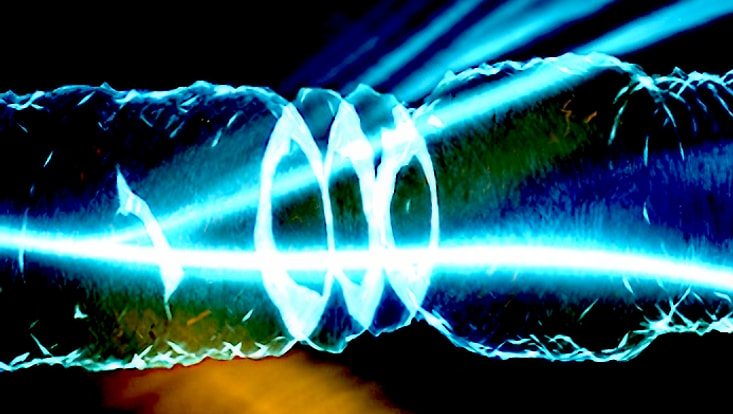
Photo: TII Abu Dhabi, edited
Watch water spiral down a bathroom drain and you are looking at one of the most stubborn puzzles in physics. Vortices, the swirling structures behind everything from turbulence around aircraft to the churn of weather systems, have resisted a complete scientific description for many decades. Now imagine shrinking that whirlpool down to the quantum scale, where the rules change entirely, and then being able to create and control it at the push of a button.
In the quantum realm, vortices behave very differently from their everyday cousins. The circulation of matter around a quantum vortex core cannot be set to any value; it is locked into fixed, discrete quanta. These structures sit at the center of some of the hardest open problems in modern physics, including quantum turbulence and quantum dissipation, and the same physics appears in superconductors, neutron stars, and other quantum systems. Despite decades of research, generating and manipulating individual quantum vortices with precise control had remained one of the major challenges in the field.
“Quantum vortices are the elementary building blocks of superfluids, extraordinary states of matter in which atoms move collectively without friction,” explains lead author Dr. Vijay Singh from the Technology Innovation Institute in Abu Dhabi and former researcher at the University of Hamburg. “So far, generating them deterministically, with precise control over their number and dynamics, has been extremely difficult. Our work shows that driven superfluids can be transformed into programmable sources of three-dimensional quantum vortices, enabling entirely new classes of experiments that were previously impossible.”
The result builds directly on the team’s earlier breakthrough published in Science, which reported the first experimental observation of Shapiro steps on a driven atomic Josephson junction. However, instead of carrying electrical current between superconductors, an atomic Josephson junction controls the coherent flow of ultracold atoms between two Bose–Einstein condensates separated by a microscopic barrier.
“By tuning the properties of that junction, we also resolved a long-standing problem in nonlinear physics: the crossover between vortex rings and vortex-free rarefaction pulses, two fundamentally different ways in which energy can travel through a quantum fluid”, explains Prof. Ludwig Mathey who is a researcher at the Cluster of Excellence “CUI: Advanced Imaging of Matter”.
The work opens exciting prospects for quantum simulation, precision sensing, and future quantum technologies based on coherent matter waves. The findings arrive at a moment of rapidly growing international interest in atomtronics. Controlled quantum vortices could become key building blocks for future quantum sensors, inertial navigation systems, analog quantum simulators, and programmable quantum-fluid circuits. They also offer an ideal platform for studying turbulence and nonlinear dynamics under precisely controlled laboratory conditions. Text: TII Abu Dhabi, ed.
Vijay Pal Singh, Ludwig Mathey, Herwig Ott, and Luigi Amico
PNAS 123 (28) e2535111123 (2026)
Erik Bernhart, Marvin Röhrle, Vijay Pal Singh, Ludwig Mathey, Luigi Amico, and Herwig Ott
Science 390, 6778 (2025)