CUI: Advanced Imaging of Matter
Cluster of ExcellenceCUI: Advanced
Imaging of Matter
Imaging of Matter
Photo: UHH/Denstorf
29 July 2026
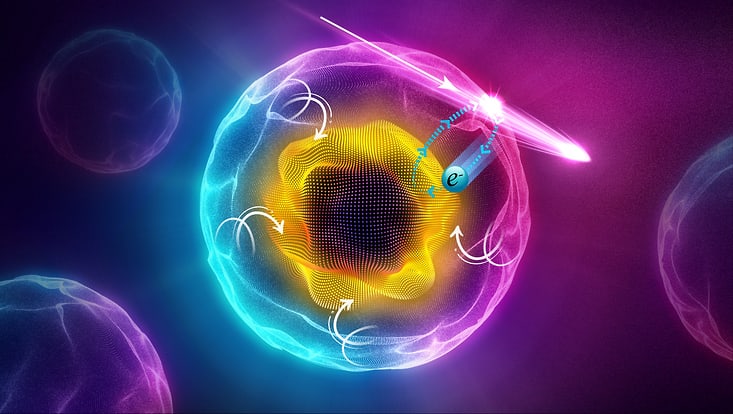
Photo: Stacy Huang
The interaction between X-rays and matter can be actively controlled: an international research team led by the University of Hamburg and SLAC National Accelerator Laboratory has succeeded in producing bright X-ray images that come with significantly less damage. In Nature Communications, the researchers report the use of ultrafast pulses that partially reverse the damage they generate.
X-rays are ionizing radiation and can damage virtually all matter. That is why radiologists strive to keep the X-ray dose in imaging as low as possible. At the same time, they must ensure the image is bright enough and contains sufficient detail for diagnosis. This trade-off has shaped X-ray imaging for decades.
Researchers who want to image chemical reactions in individual molecules and nanoparticles face a far more extreme version of the same problem. To capture something as small and fleeting as a reaction within a cluster of atoms, they must illuminate the sample with a large number of X-ray photons in an extremely short burst. The most advanced tools for this—X-ray free-electron lasers (XFELs)—produce flashes short enough to “outrun” the physical destruction of the sample. However, even these short pulses strip electrons from atoms and turn a solid structure into a cloud of ions and electrons before a usable image can be recorded. This so-called “electronic bleaching” has long been considered an unavoidable limitation of high-resolution X-ray imaging. Once the sample bleaches, it becomes more transparent to X-rays, and image quality and resolution deteriorate.
In the current study, the team reports a way to mitigate this bleaching—even when the X-ray dose is pushed to extreme levels.
To achieve this, the researchers illuminated neon nanoparticles with newly available X-ray pulses lasting only a few hundred attoseconds. These pulses were roughly one hundred to one thousand times shorter than those used in earlier FEL imaging experiments. By tuning these ultrashort flashes near the neon K-edge (an energy at which neon atoms respond especially strongly to X-rays), the researchers made an unexpected observation: the pulses did not only outrun the damage more effectively, they also actively reversed part of it while the irradiation was still taking place.
“When intense X-rays hit a sample, they normally knock electrons out of their original state. According to accepted wisdom, once this damage has been triggered, it cannot be undone during exposure,” says Anatoli Ulmer, the study’s first author. “Attosecond-scale pulses break this cycle by outrunning the usual damage cascade. In addition, we observed a competing process: stimulated emission. In this case, the X-rays push some electrons back toward their original state. Stimulated emission therefore actively reduces electronic bleaching.”
To narrow down the effect of stimulated emission, the team compared the impact of 300-attosecond pulses with pulses that lasted 50 times longer at similar brightness. When pulses are very short, many of the mechanisms responsible for bleaching may not even have time to begin. The longer pulses produced a hot, dense cloud of free electrons. Even though the ions themselves hardly move, this nanoplasma ultimately blurs the structural information in the sample.
In contrast, the ultrafast pulses reflect more electrons that remained coupled to their parent ions. This produced an image that represents the sample far more accurately—just as it existed before the X-rays arrived.
In addition, the X-ray signal from the attosecond pulses was significantly stronger even though the sample was ionized less. “We were very surprised to see that brighter images come with less damage,” says Tais Gorkhover, Professor at the University of Hamburg and researcher at the Cluster of Excellence ‘CUI: Advanced Imaging of Matter’. “It’s a bit like reflecting more and more sunlight off a metal roof without the roof getting any hotter.” This effect can also be explained theoretically through stimulated emission: electrons can be driven back toward their original ions by X-ray light, as long as bleaching has not progressed too far.
The results shift attention away from the previously rather passive approach to improving X-ray imaging. Instead of viewing damage as a kind of race that can be won purely by shorter exposures or limited X-ray doses, the findings suggest that the interaction between X-rays and matter can be actively steered. With the same intense light that causes the damage, it is also possible to counteract it at least partially.
“This work points to a future in which we can tailor matter’s X-ray response by controlling ultrafast electronic dynamics and ultimately influence how X-rays are absorbed, scattered, and propagated through materials,” says Phay Ho, one of the lead scientists of the study.
A. Ulmer, P. J. Ho, B. Langbehn et al.
Nat Commun 17, 7556 (2026)