CUI: Advanced Imaging of Matter
Cluster of ExcellenceCUI: Advanced
Imaging of Matter
Imaging of Matter
Photo: UHH/Denstorf
9 June 2026

Photo: Electron Studios, UHH, AG Moritz
Research with ultracold gas clouds shows the conditions under which superfluidity – flow without friction – is particularly stable. The new findings could help to better understand the behavior of a whole range of quantum systems. Part 2 of our series from the new magazine Advanced Imaging of Matter: Seven Years CUI in Focus describes the experimental work on superconductivity and superfluids, which are of outstanding importance in modern physics.
Superfluidity is one of the most striking phenomena of quantum mechanics. Our everyday experience teaches us that friction occurs with every movement. In the case of superfluids, however, their components flow completely without friction below a certain temperature. If these components are electrons in a solid, we speak of superconductivity. Superconductivity is particularly relevant for real world applications, as superconducting cables can be used to transport energy in a completely loss-free manner, allowing very high magnetic fields to be generated in MRI scanners, for example. However, superconductivity and superfluidity currently only occur at very low temperatures, and our understanding of the underlying mechanisms is still incomplete, making it difficult to open up further areas of application.
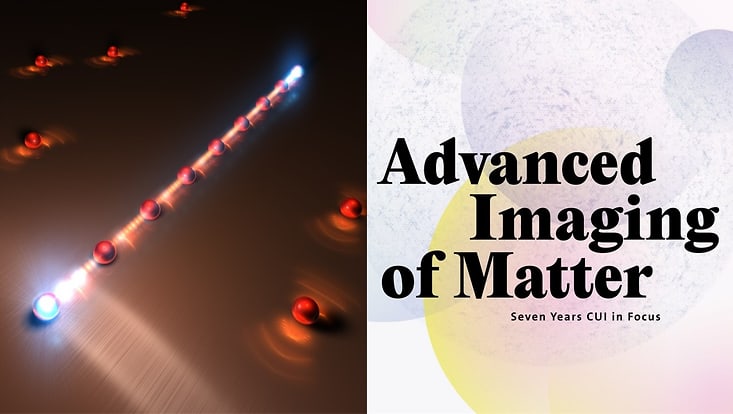
In order to close the gaps in our fundamental understanding of superfluidity, Prof. Henning Moritz and his team are working with samples that, at first glance, have nothing to do with electrons flowing through solids. The researchers use laser light to cool atoms in a gas cloud to temperatures of a few billionths of a degree above absolute zero. This makes the gas superfluid. “We can then change many properties in these ultracold gases and photograph the atoms directly – which is not possible in solid matter,“ explains Moritz.
However, the quantum mechanical principles that choreograph the dance of the atoms through the light fields are, in important aspects, the same as those that determine how electrons move in matter. This means that insights from the extremely flexible atomic system can be transferred to other quantum systems that are less easy to control. This type of replication of one quantum system by another is known as quantum simulation. “For example, it is possible to capture several thousand ultracold atoms in light fields in such a way that they can only move in two dimensions, like pieces on a chessboard,“ says Moritz. Cluster researchers were able to prove that these two-dimensional gases are indeed superfluid. To do this, they moved interfering laser beams through the gas, which pushed the atoms away like a spoon stirring coffee. The atoms flowed perfectly around the laser beams without any friction, confirming their superfluid nature.
They also investigated the conditions under which superfluidity can be destroyed. To do this, they changed the crossing angle of the laser beams and their energy difference, which allowed them to measure the properties of the superfluid. “What was particularly surprising was that we observed that the superfluids created in this way are equally stable – regardless of whether the particles can only move in two spatial directions or in three spatial directions as usual,” explains PhD student Lennart Sobirey, the first author of the corresponding publications. “What is more important is that the atoms form pairs. The size of these pairs in relation to the average distance between the particles seems to be crucial for stability.” This finding is highly relevant for understanding so-called high-temperature superconductors – i. e. superconductors that still exhibit lossless current conduction at higher temperatures. However, these temperatures are still well below – 100 °C. High-temperature superconductors typically consist of numerous two-dimensional layers, and for decades there has been debate as to whether this layer structure is central to the high critical temperatures of these superconductors.
Another example of the possibilities opened up by ultracold gases is the observation of the so-called Josephson effect, which Cluster researchers reported on in a highly acclaimed paper in the renowned journal Science. To do this, they separated the gas into two parts using a wall of light. Contrary to what one would expect in the context of classical physics, the ultracold atoms can penetrate this barrier due to the quantum mechanical tunneling effect, even if the barrier is higher than the level of the gases. “What is even more remarkable is that this particle current can flow even if the level is the same on both sides or if the current has to flow slightly uphill,” explains Niclas Luick, the first author of this study. “However, the liquids on both sides must be superfluids.” This phenomenon was predicted by British physicist Brian Josephson during his doctoral thesis in 1962 and is of such fundamental importance that he was awarded the Nobel Prize in Physics for it in 1973. The current is driven exclusively by the wave nature of the superfluids. Among other things, it can cause the superfluid to start oscillating back and forth across the barrier.
It is precisely these Josephson oscillations that also appear to be central to light-induced superconductivity at room temperature, which was observed in Prof. Andrea Cavalleri's research group. In a series of ground-breaking studies, his group has succeeded, for the first time worldwide, in observing superconductivity at room temperature for a short time by exposing known superconducting materials to short pulses of light (see page 14 in Advanced Imaging of Matter - Seven Years CUI in focus). His joint work with the theory groups of Prof. Dieter Jaksch, Prof. Ludwig Mathey and Prof. Angel Rubio to explain this surprising behavior is an excellent example of the added value that collaborations within the Cluster can bring.
The experimental work from Prof. Moritz's research group on superconductivity and superfluidity - a central research topic in the Cluster of Excellence - further emphasizes how research topics are approached from different angles and with complementary techniques. "Experiments with ultracold quantum gases open up many new opportunities for us to gain insights into the nature of super-fluids," says Henning Moritz. "These systems are of outstanding importance in modern physics but are very difficult to grasp theoretically. We are delighted to be able to contribute to a better understanding of these quantum systems with our research in the Cluster of Excellence.” Text: Henning Moritz, UHH